
6 steps to AI search optimization
Author:John Doe
Date:May 15, 2026
Optimizing for AI search requires two complementary approaches: lab data from prompt tracking tools shows you how your brand appears across AI platforms, while field data from log analysis reveals real bot behaviour on your site.
This six-step journey shows you when to use each approach to build a complete AI search optimization strategy.
Whether users are searching through AI assistants, conversational search engines, or generative AI platforms, businesses need a new optimization strategy — one designed for AI search.
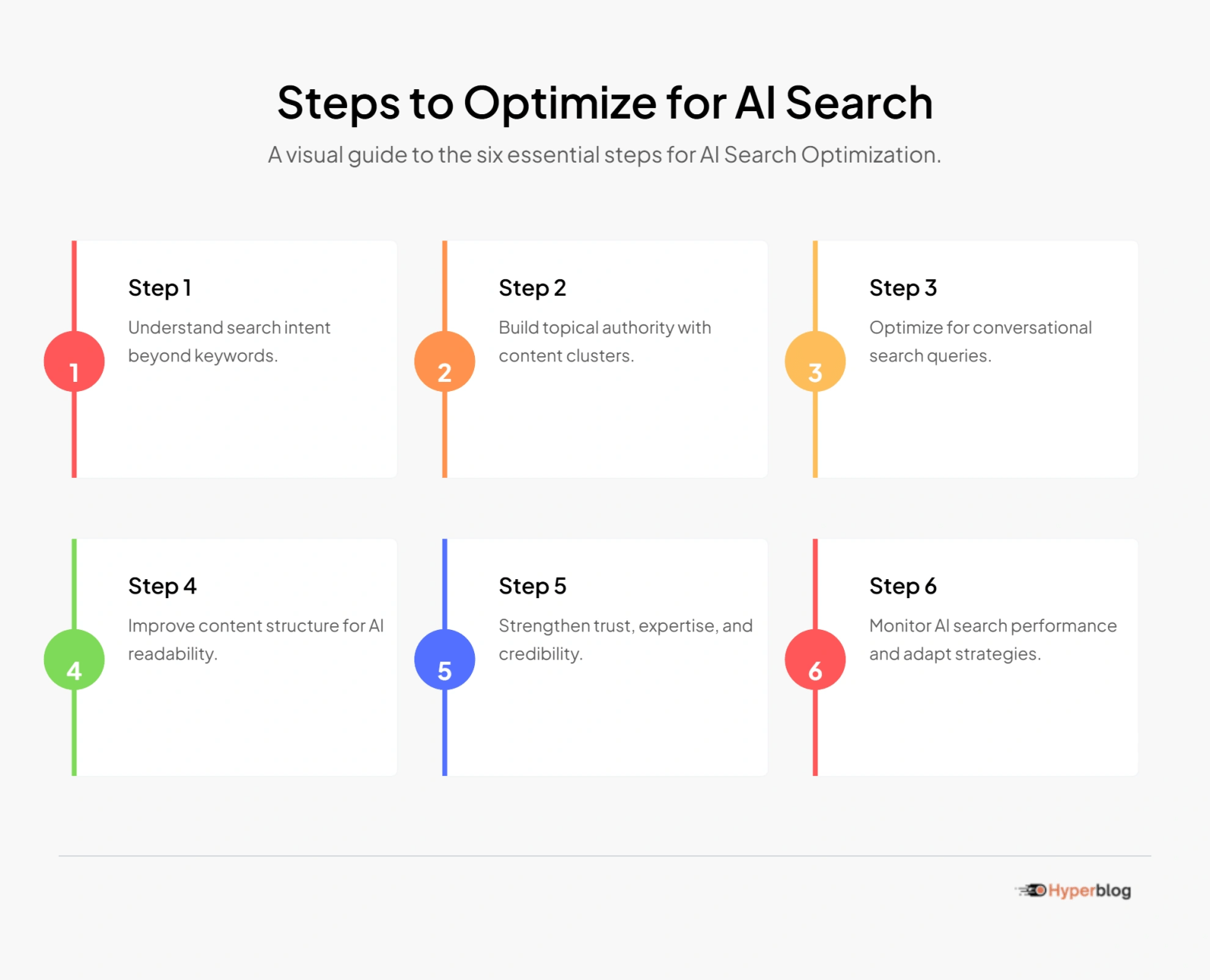
Here’s a practical guide to the six essential steps for AI Search Optimization (AISO).
Artificial Intelligence is changing the way people search online. Traditional SEO focused on ranking pages for keywords. AI-powered search engines now focus on understanding intent, context, credibility, and user satisfaction.
Whether users are searching through AI assistants, conversational search engines, or generative AI platforms, businesses need a new optimization strategy — one designed for AI search.
Here’s a practical guide to the six essential steps for AI Search Optimization (AISO).
Traditional SEO often prioritized exact-match keywords. AI search systems go deeper by analyzing:
Instead of optimizing only for terms like:
“best CRM software”
You should also optimize for natural language queries such as:
The goal is to become the most complete answer for a topic.
What do you find most challenging in AI Search Optimization?
AI search engines prioritize sources that consistently demonstrate expertise.
Publishing random articles around unrelated topics no longer works effectively. Instead, create content clusters that establish your authority in a niche.
If your niche is digital marketing, build interconnected content around:

Download our in-depth guide to mastering AI Search Optimization for your business.
The more comprehensive your topical coverage, the more AI systems trust your website as a reliable source.
AI search is conversational by nature. Users increasingly search using full sentences and voice queries.
“weather app”
“What’s the best weather app for travellers with offline forecasts?”
Your content should mirror how real people speak.
This improves visibility in:
AI systems extract and summarize information quickly. Poorly structured content reduces visibility.
Well-organized content is easier for AI models to understand and cite.
AI search engines increasingly evaluate:
Low-quality, AI-generated spam content performs poorly over time.
Search engines want to recommend content users can trust.
Human expertise matters more than ever in the AI era.
AI search is evolving rapidly. Optimization is no longer a one-time process.
Track:
AI algorithms change frequently. Businesses that continuously adapt will gain long-term visibility.
AI Search Optimization is the next evolution of SEO.
Success now depends on:
AI Search Optimization involves adapting SEO strategies to align with AI-driven search engines, focusing on user intent, conversational queries, and credibility.
Understanding search intent helps create content that matches what users are looking for, improving visibility in AI-driven search results.
Create interconnected content clusters around a specific niche to demonstrate expertise and authority to AI search engines.
Conversational search involves using natural language queries and voice searches, requiring content to be written in a conversational style.
Use tools like Google Search Console and AI visibility tracking tools to track engagement metrics and adapt strategies accordingly.
Brands that optimize for AI-driven discovery today will have a major advantage as search becomes increasingly intelligent and conversational.
The future of search is not just about rankings — it’s about becoming the best answer.
Subscribe to Our Newsletter
Stay up to date with our latest news and updates.